

Pad-and-Fan vs Fogging
When we start thinking about cooling, this is the question we usually get asked first. And it’s actually jumping ahead…
Pad-and-fan and fogging aren't rivals. They're different expressions of the same cooling principle, each one suited to a different kind of greenhouse.
Once you see how that works, the decision that actually matters comes into focus. And it's bigger and more interesting than most growers realise. Get that step wrong and no amount of fan capacity or misting pressure will control your climate to your crop’s needs.
But before we get there, let’s understand these systems a bit better. Once we do, the rest more or less solves itself.
What the two systems have in common matters more than what separates them.
Pad-and-fan cooling and high-pressure fogging both rely on a scientific principle known as adiabatic cooling. When water evaporates, it pulls heat out of the surrounding air and drops the temperature. There’s no machinery involved. Just water and air meeting under the right conditions to produce a cooling effect.
You already know what this feels like. It's how sweat cools you down on a hot day. The water leaving your skin takes heat with it, and your body temperature comes down. Your greenhouse works on exactly the same principle, only at a much larger scale and with deliberately engineered conditions.
But evaporative cooling has a ceiling, and it's set by the air itself. Air can only hold so much moisture before it hits saturation. And once it's saturated, no more water can evaporate into it, which means no more cooling can happen. Dry air has lots of room to absorb water. Humid air has almost none.
This is the most important thing to understand about evaporative cooling. It's the reason a pad-and-fan system that delivers a 13°C temperature drop in the Northern Cape might only manage 4 or 5°C on the Mozambique coast. Same system, same pump, same fans, but a different ceiling, because the incoming air is different.
It's the reason your external climate dictates so much of what's possible in a greenhouse project, long before you start choosing fans and pads.

How Pad and Fan works
Pad and fan is the better-known system, and probably the one you know of. Here's what's happening inside one:
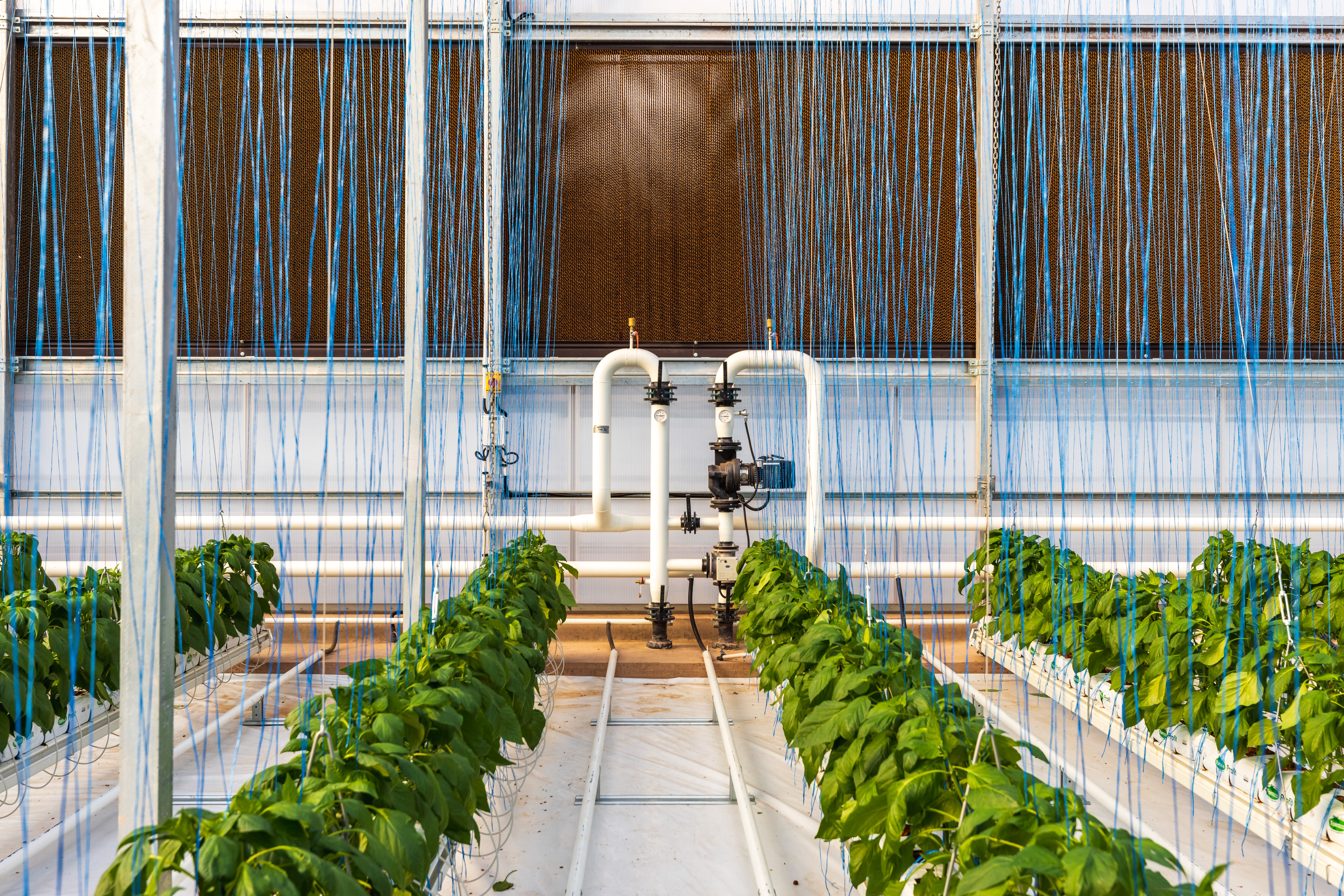
One wall of the greenhouse holds a wet pad, usually cellulose, kept damp by a pump that recirculates water from a sump tank. The opposite wall holds a bank of extraction fans. When those fans run, they pull air out of the greenhouse. Because the structure is sealed everywhere else, the only place replacement air can enter is through the wet pad. Outside air gets pulled through the damp pad, loses heat as the water evaporates, and arrives in the greenhouse several degrees cooler than outside.
The airflow is directional: pad on one side, fans on the other, and the entire greenhouse sits in the stream between them. Simple and elegant, with one built-in problem you have to design around.
The air warms as it crosses the greenhouse, which means plants near the pad sit in cooler conditions than plants near the fans. The gradient is unavoidable. The engineering job is keeping it small. Well-designed systems hold the difference to 2–3°C across the crop. Poorly designed ones can drift to 10°C or more, and at that point, your "controlled climate" is really two different climates sharing a roof.

How fogging works
Fogging takes the same physics and rearranges it. Instead of drawing outside air through a wet pad, fogging pumps ultra-fine water droplets directly into the greenhouse air. Those droplets evaporate almost instantly, cooling the air as they go and raising humidity with them.
Droplet size is important here. Too large and they don't evaporate before they land on your plants, turning your cooling system into a sprinkler. But get droplets fine enough, and they vanish into the air completely, adding moisture without wetting the crops.
Because the cooling happens throughout the greenhouse rather than at one wall, fogging suits naturally ventilated structures. Air exchange happens through roof vents and sidewall openings across the greenhouse.
You can't install a wet pad in a building full of vents. But you can pulse fog across the entire space and let the natural airflow carry the cooled, moister air out.

The real question is “closed vs naturally ventilated?”
The real choice isn't pad-and-fan versus fogging. It's between two entirely different kinds of greenhouse: Either a closed greenhouse, sealed on every side, that relies on mechanical ventilation to move air through it. Or a naturally ventilated greenhouse, full of roof and sidewall vents, relying on outside wind to drive air exchange.
Pad and fan goes with the first. Fogging goes with the second. The cooling method follows the chosen ventilation of the structure, not the other way around.
The difference matters for one reason: predictability. With mechanical ventilation, we can guarantee the number of air exchanges per hour. It's a mathematical output of fan capacity and greenhouse volume, and it doesn't depend on outside weather. With natural ventilation, the air exchange rate depends on the wind, making it inherently unpredictable.
Think of it as the difference between running air conditioning and opening windows. Both move air. Only one lets you plan the result.

Your climate decides
Choosing a structure depends on where you're farming. What works beautifully in one region is counterproductive in another, and the line between them is based on climate data, not sales brochures.
Hot and dry climates are ideal for both systems. The Northern Cape, the Karoo, and most of the Middle East all have low ambient humidity. The air is dry, so you have enormous headroom to add moisture before hitting saturation. Well-designed systems can pull incoming air temperature down by 12 to 13°C.
For hot and humid climates, this approach is much less effective. Limpopo summers, coastal KZN, Mozambique, and the tropics further north share high humidity. At 70% humidity, the same evaporative system that delivers a 13°C drop in the desert might manage 4 or 5°C. It'll also push the greenhouse toward disease risk while it's doing it.
Mixed climates sit in between. Cape Town's Mediterranean summers are ideal for evaporative cooling; winters, with low radiation and high humidity, are not.
The uncomfortable truth is that some climates are hostile to greenhouse production in certain seasons. Commercial growers deal with this by operating across multiple sites, matching their crop to the season rather than the other way around.

Climate control is a craft, not a switch.
Whether it’s the first question to ask, or all the questions in between, we think of everything. Each greenhouse is like a puzzle to our engineers, and we solve it meticulously.
Climate control is a craft. Not only across changing seasons, but also the changes your crop goes through as it matures. The technology gives you control. The craft of controlling the climate to produce what you need, when you need it gives you results.
If you're weighing up a greenhouse project and want to think through what would actually work for your climate, crop, and goals, we’d love to collaborate with you.
Reach out on +27 21 987 6980 or info@vegtech.co.za

Comments
We'd love to hear your thoughts! To enter a comment, type your name and email address.